
Got your snowboard, got your snowboard bindings, now what? Learn how to set the correct snowboard stance or how to adapt it to your stile of riding! Changing the stance angles, width or setback can make a lot of difference, but there is no right or wrong setup as long as you stay within the limits. What feels best probably works best. Also – I suggest you also read the article about mounting your bindings. There are a few useful tips there will also help you fine tune your stance. OK, now to those annoying details.
Table of Contents
How to set your snowboard stance?
There are three basic measurements you need to decide on when you are playing with your stance:
- stance setback
- stance width
- stance angles
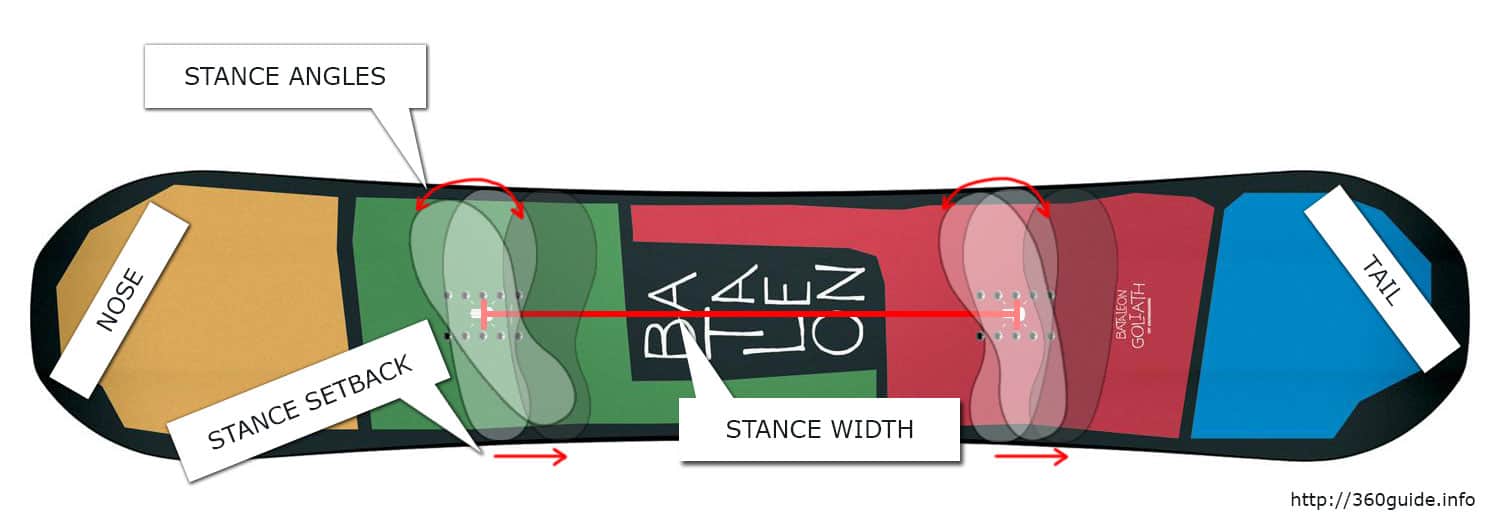
Setback and width are usually set when you mount your bindings and then you usually leave them alone. You can and should play a bit more with your stance angles to find out what feels best for you. Here is a diagram that shows what each of the terms mean:
Setback
What is snowboard stance setback (offset)?
Stance setback is the distance that tells us how far back the center between the bindings is from the center of the snowboard (actually from the effective edge center of the snowboard, nose and tail can be different length, but do not influence the effective edge center of the snowboard).
Are the inserts always in the middle of your board?
Snowboard inserts are two metal pieces integrated into the snowboard that have several holes, which are used for mounting your bindings onto the snowboard. When you mount your bindings you need to know if the inserts already have some setback put in. That means they are not centered in the middle of the snowboard but set a little towards the tail. In this case – even if you put your bindings in the center holes, they will be a little closer to the tail of the snowboard. Insert setback is very common and the amount of setback is related to the type of snowboard (freeride, freestyle…).
Why stance setback?
Standing a bit more towards the back of the snowboard puts more weight on the tail and keeps the nose out of snow. That is a very good idea in deep powder, not so useful in the park. This is why freeride boards have inserts setback and 100% freestyle snowboards do not.
What setback to use?
If you are asking this you should put your bindings in the center holes. Since the insert setback is already integrated into the snowboard you will be just fine. Only if you have some special needs like – you are going to ride really deep and soft powder, then mess with the setback and put your bindings one hole towards the snowboards tail. If you are changing your setback – setback should never be negative (bindings should never be moved towards the nose)!
What Works Where?
- zero stance setback or centered stance – snowboard turns easily and you will have a good board control
- default holes are normally set backward for about 1 inch (or 25mm) – snowboard will behave as if it has a shorter and stiffer tail, you can make more aggressive turns, ollie higher, and float more easily in the powder
- more setback, up to 2 inch setback (50mm) – to ride deep powder in a more relaxed stance without worrying about a nosedive into the deep snow (if you set your bindings too far backwards, snowboard will be harder to turn).
Width
What is snowboard stance width?
It is the distance between the centers of both bindings and it simply tells you how far apart are your feet when you are strapped in. It depends mostly on your height. The width should be roughly equal to the distance from the middle of your kneecap to the ground, or about 1 inch (2.5 cm) more than the width of your shoulders. If you have chosen the right board for your length, then you shouldn’t worry much about the stance width as it should be about the same as distance between the default holes on the board. If you are not an expert snowboarder just let it be.
What Works Where?
It effects your board control and you can feel even small changes that you make to your stance width:
- Wide stance – more stability, harder turn transitions (used more by freestyle snowboarders)
- Narrow stance – less stability, easier turn transitions (used more by freeride snowboarders)
Snowboard Stance Width Chart
Since we are all built differently and have different snowboarding styles it’s IMHO impossible to make exact calculation how wide should your feet be, no snowboard stance width calculator will help you. But for some reference you can use these numbers and then see how it fels:
| height (m) | height (feet) | width (inch) |
|---|---|---|
| < 1.54 | < 5’1″ | 17-18 |
| 1.56 – 1.62 | 5’2″ – 5’4″ | 18-19 |
| 1.65 – 1.72 | 5’5″ – 5’8″ | 19-20 |
| 1.75 – 1.82 | 5’9″ – 6′ | 20-21 |
| > 1.82 | > 6′ | 22-23 |
Stance angles
Am I Regular or Goofy – what is regular and goofy snowboard stance?
If you do not already know, now is the final time to find out what your stance type is. Are you goofy or are you regular. The difference between the two is which leg goes in front. If you put your left foot in front when you go downhill, you are regular and if it is your right foot you are goofy. Most of the snowboarders are regular but that doesn’t mean you are too. Using the right stance type makes it much easier to learn snowboarding.
How Do I Know If I Am Goofy Or Regular?
If you skateboard, wakeboard, surf etc… then you already know your stance, just use the same one for snowboarding. If not – there are a few tests to discover your stance orientation:
- try sliding in your socks over smooth surface, the foot you put in front normally corresponds with your stance,
- borrow a skateboard and try which foot feels better,
- stand on the floor like you are snowboarding and put left foot forward and then right foot forward – imagine that you are riding, what feels better?
- the last and most sure test of your stance type is the first day of snowboarding – try it both ways and you will feel the difference!
Is there a difference between goofy and regular snowboards?
No :)! It’s the same board, you are just standing on it facing the other way.
What are stance angles?
Stance angle is the angle at which the snowboard binding is mounted on to the snowboard. If the binding is totally perpendicular to the snowboard length the angle is zero. If the front of the binding (your toes) is angled towards the nose of the snowboard, you have a positive stance angle and if the front of the binding (your toes) is angled towards the tail, you have a negative stance angle.
Every binding that you buy allows you to set and change your angles.
When we are talking about stance angles they are usually described with two numbers: +24°/+9° for instance. That would mean that the front binding is set at 24 degrees (positive stance angle) and the back binding is set at 9 degrees (also positive stance angle).
Stance angles should be always in sync. If the front angle is bigger then the rear angle should also be bigger and vice versa. Do not make a really big angle difference between both bindings because it will make you stand in an unnatural position and you can damage your knees. The goal is to always put your body and knees in a natural position. Rear angle should never be larger than the front angle! Depending on the angles you have a ref typical stances:
- Alpine stance
- Forward stance
- Duck stance
Alpine Stance
This is a setup used for alpine (or race, or carve) snowboards. These snowboards are so narrow that small stance angles are impossible since your feet will quickly overhang your snowboard and you will wipe out. Front and rear angles are anywhere between +70° and +35° degrees and are usually set by the width of the snowboard. These angles together with hard boots allow you to carve aggressively. For better control in short turns, the difference between the front and rear angle should be at least 5°.
Forward stance
This is the usual stance used by most of snowboarders. Both snowboard bindings have positive stance angles but they are much smaller than with alpine stance. Angles can be smaller because the regular snowboards (freeride and freestyle snowboards) are much wider than race snowboards. Typical angles can vary between +40° and +15° degrees for the front binding and between +30° and 0° degrees for the rear binding.
A general rule is that you should keep the difference between the front and rear angle under 21° degrees. Some typical setups:
- Stance angles: +21° on the front and +6° on the rear – this is a common all-mountain setup,
- Stance angles: +30° on the front and +15° on the rear – this is common setup if you are more carving oriented rider or if you are just starting out (stance for learning how to snowboard).
Duck stance
This is a stance where the front binding angle is positive and the back binding angle is negative. This stance makes your toes face different directions like Donald ducks feet. Duckstance gives you more stability as your body is aligned with the snowboard and is useful for freestyle and riding halfpipe. With duck stance, the front angle is anywhere between 30° and 0° degrees while the rear angle is negative, between -1° and -20°. Keep the angles apart by at least 10 degrees. Typical setups :
- Stance angles: +18° on the front and -6° on the rear – this is more laid back duckstance
- Stance angles: +15° on the front and -15° on the rear – this is 100% (mirror) duckstance.
Toe overhang
Toe (or heel) overhang happens when your snowboard boots hang over the snowboard or better – over the snowboards edge. This must be avoided, because if your boot overhangs the front edge it will come in the contact with the snow when you turn frontside. Your boot will cause the snowboard edge to loose contact with the snow and you will fall on your face. If your overhang is smallish this will only happen with deep carving turns. As readers pointed out – some overhang is absolutely normal and it actually helps with initiating turns. Strap the boots onto the board a see how far you would have to lean to touch the ground with your toes…
To get rid of the overhang you must adjust your stance angles. With the boot centered in a binding, rotate the binding until the boot toe and heel are only a little over the edge of the board. The larger your snowboard boot is, the greater angle you must use. If your feet are really big you should consider buying a wider snowboard. There are special WIDE snowboard models, that are (duh!) wider than regular snowboards and are made for people with big feet.
On the other hand – if your feet are not too big DON’T get a wide snowboard. If your toes and/or heels don’t reach all the way to the edge you will have trouble putting your board on the edge and snowboarding will be really weird and difficult. The same can happen if your stance angles are too big. This is not a common problem since most people don’t want big angles but still – if the angles are too big the boots are inside the edges and you will not be able to put enough pressure on them.
Choosing your stance angle
I’ve said it at the beginning – there is no right or wrong snowboard stance (if you stick to the limits mentioned above). Start with a commonly used stance, bring a screwdriver with you and play with your angles. What feels right usually works.
Oh, one more really important rule.
No Friends On Powder Day Rule
This is a very important rule.
DON’T EVER NEVER NEVER EVER ADJUST YOUR STANCE BEFORE THE FIRST POWDER RUN OF THE DAY WHILE YOUR FRIENDS ARE WAITING!
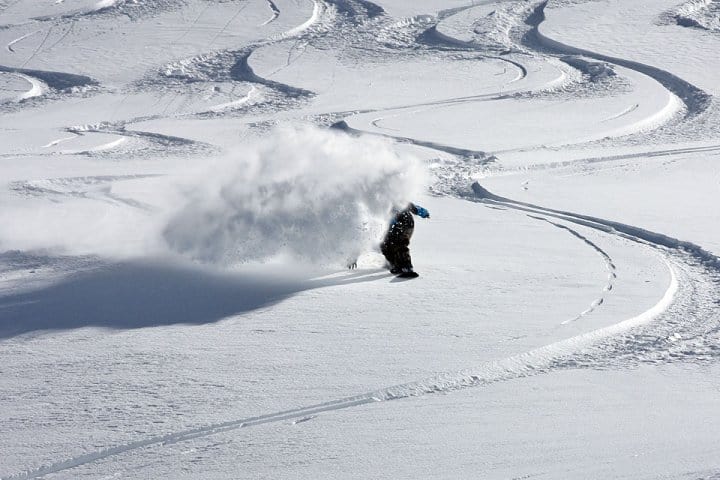
It’s been snowing whole day and most of the night. You wake up to bluebird skies, grab a bite and run to the mountains. Even though you woke up really early you are surprisingly not the only one with this idea (huh?). To be the first at the top of the hill and draw a line over virgin fresh fluffy powder. You use your elbows to push yourself to the front of the line. Lift opens and you are on the first chair up the mountain. You get off, strap in as quickly as possible and…”Hey, can you wait for me? I just have to adjust my stance for powder…“. It’s your best friend.
Or should I say your ex best friend.
You smile, inhale, and drop in :).
Set you stance at home!
PS: There is also lost of useful info in the comments, read them!:)
PPS: If you like this guide please share it on FB/Twitter etc. Many thanks!
Thanks for the informative guide.
Sweet website dude, it’s well written so it’s relaxed and not over the top 1950’s doc., and it has some great info!
thanks !
Hi Guys great website.
Thought your readers would like to hear about a new device which addresses the age old problem of “which snowboard stance is right for me”?
The StanceFind™ machine is the world’s first dynamic board riders’ stance calibration device. Developed by professionals and tried and tested by expert and novice alike, StanceFind™ is the only accurate way to determine the stance that suits YOU.
StanceFindâ„¢ will be available at select retailers in Colorado and Europe for the start of the 07/08 season.
Check it out at http://www.cre8iv-uk.com/stancefind.htm
I’ve been snowboarding for 5 seasons, and i am gonna try more park this year. I read through your guide for width and angle adjustment. I have decided to make my stance an inch or 2 wider, and install my bindings in the “laid back duck” stance. thanks so much for this guide! ;D
With the help of this site, I was comfortable during the setup of my first snowboard. Thankyou
Thanks again. Blogging is hard work :)
Great info! I thought I was the only one with a 30/15 setup on a freeride board(grew up with a hardboot/carving setup).
Just a small typo; under “why different snowboard stance width”, a narrow stance is used more by freeride snowboarders no?
Ups, you are right dswissmiss, it should say freeride. Thanks!!!
Going back the to the toe overhang. you wouldnt have to necessarily get a new wider board. All you gotta do is invest in some risers which lifts your feet up. this is obeying the law of physics
great guide, it’s very helpful! but i have a question that the guide does not seem to address. what is the advantage of setting up your bindings with steeper, positive angles? I understand this will rotate your your hips forward keeping your body “focused” downhill to simplify transitions, but do higher angles affect the amount of leverage that can be applied to your board while turning? if anyone has an answer it would be appreciated.
Yes, if you have only a little toe overhang problem you can also get raisers or gas pedals for your toes. I find it a bit clumsy :) well, if you have really big feet, you really should get a wider board.
Hm, I would say that with steeper angles the body of the snowboarder is better aligned for deep carving turns and the body movement is more natural, maybe even the force is more focused on to the snowboard rails, so they hold better. But I wouldn’t say that the force itself is bigger because of the steeper angles.
You do however get more centripetal force when doing carving turns… not sure if this answers your question :) just my 5c :)
thanks boarder i appreciate the nickel. the reason i ask is that i have been a casual rider for a few years, but recently i have become addicted to speed. i am a small guy and NOT very strong. my understanding is a close binding set-up puts alot of pressure on the thighs (quads). if i keep my bindings around 24, 10, and preferably a 25 inch stance, then i can get low to utilize more power from my glutes (a bigger muscle group) and lower center of gravity to rail turns. i was wondering if i was thinking about this problem the wrong way. i just haven’t had time get out there and experiment with a different setup.
lastly, i understand that the amount of force you can exert on your board really dosen’t change upon binding placement; only your mass and gravity can determine that. but if your bindings are closer together, the force you are applying to the board is over a smaller surface area. this will allow someone to apply the same force as another who is riding a wider stance more effectively into a turn (by loading the camber more evenly, which will flex the heck out of that board, thus dig into that carve!). i guess i was wondering if in a wider stance would (like my 25 inch stance which may only be 1-3 inches wider than an average freeriders stance over a 63 inch snowboard) would affect my ability to direct the board? my intuition tells me no. but if i am going straight down the hill, who needs to turn anyways? just my 1c ;)
face_plant
Hey bro, can you comment on the placement of bindings, with regards to the toe and heel edge. That is, the screws in my baseplates can be moved to move my bindings closer to either the toe or the heel edge. How do you know what you want? I know that you don’t want any toe hang, but but how do you know if you’re shifted too much toward the heel edge?
Hey, you want to stay centered over the middle of your stick, this is best for your balance. I would only move the bindings back if I would have toe overhang problem in which case that would again make me centered over the board.
So I’m a relatively new snowboarder who was using step in bindings and doing great on them. I got a new board and new strap in bindings and boots and went on up the chairlift. I then realized I COULD NOT SNOWBOARD!!! I’m 5’2, the board goes up to my chin, I used my old binding placements which were 19″ apart, 15 on the front and 0 on the back. Is there a better way to place my new bindings so I can actually turn my snowbard. Maybe it’s the sharp edges I’m not use to but whatever it is it has to be fixed. Please help.
Your old binding placement should work, but there is no wrong or right angles, try experimenting a little. Otherwise I would say that the “problem” is in your new board, not the bindings. Bindings can give you different feel how your legs are attached to the board, but the snowboarding motion, snowboarding feeling stays the same. But another, new board can handle and ride quite different from your old stick. You can have different sidecut, different stiffness… that shows a lot when you first step on a new board. You just need to get used to it.
can normal sized riders, ie normal feet size, use wide boards? Ive just been offered a good deal but its a W board but Im a size 9??
any help appreciated
kcearl: IMHO – don’t take it. Only if you really need your board mostly for powder, then a wide board would be the way to go.
Otherwise you will have problems turning your board from one edge to another. Well… maybe not problems, but you will feel the width and you won’t like it ;)
I’ve been boarding on and off for about 4 years now and I’ve always had problems with my front ankle. After a few hours on the slope my ankle is killing me, on the outside of the leg about 2 inches up from the ankle bone itself. I’m thinking it is something to do with my setup, either the stance angle or maybe the width. I have tried setting quite a postive front angle, 30 but although this helps a bit it doesn’t actually resolve the problem. Has anyone else had a problem like this or does anyone have a suggestion for improving things?
Thanks in advance.
I’ve had this same problem! I’ve been searching the web for any suggestions. Id love to know if you ever find an answer!
Mary
Steve: what are your stance angles? If you don’t have some really weird angle setup I think it’s more likely that your stance is to wide. But it’s really hard to say. Try borrowing different board and bindings, maybe even shoes. If you can ride switch, try riding the whole day switch and see if the pain is still there (and in the same ankle).
hi there….. i have been boarding for 3 seasons now and i am looking into buying my own Equipment…. i am lost and dont have that much info on where to start for a newbe board and binds, boots…
my mate told me to just by my boots this season then invest in the rest can u please give me advise on what to do and what to go for as of eqwipment.
mech board
Hi, I’m more of an all-mountain rider who also loves the powder. I’ve always ridden with a 15 / 0 stance and never really played around with diferent settings. If I want to make curving through pow easier, would you recommend making my rear stance positive and my front stance more aggressive?
@sm0t: well, if the stance works for you then keep it. Most of the time I use duckstance – even for powder because I am so used to it that anything else feels weird. But generally for all-mountain and freeriding you can use more aggressive stance with both angles positive. You can try it next time and see if it works for you.
I’m 5’11” and i recently moved my front binding forward to make my stance more centered (freestyle rider/freeride board). But my stance width is still only 17 inches. It feels fine on Dendex but will it be the same on snow?
Oh and my binding angles are 15 -15
@Joe: 17 inches does sound a bit narrow. The best snowboard stance width is the width of your shoulders (rotator cuff to rotator cuff, no muscles) and the distance from the bottom of your heel to the top of your knee. Measure these two, and find your stance width somewhere in between.
Cheers. but i realised i was measuring from the inside of each binding. oops
Hi, I’d love to catch your opinion on two issues of mine:
1) I’m conflicted over purchasing a strictly-freeride board for fast, black-carving and blue/black mogul runs. It’s all I do.
At the moment, I’m torn between the 08 Burton Supermodel X, the 07 Ride UL Concept, and an 08 Flow Whiskey X board.
Any pros/cons come to mind for any of these boards?
2) I could use a point in the right direction for top-of-the-line boots for the freeriding I do described above. Was currently looking at the DC Judge. Can you toss out a few boots in particular that you would recommend me to research?
Thanks in advance. – Ryan
Just a thought on this one. I had the exact same experience with a new board. I’m fairly experienced but had always ridden my reliable Burton Custom. Well, I bought a new Donek, took it to the top of the hill and could not turn it, plus I was catching my edges like crazy. Turns out the edges had not been detuned (beveled). If you’re still having problems, take the board into a tech and have them look at the edges
Great article. Love the fact that you kept it simple. I haven’t snowboarded in a couple years and your width chart gave me a great starting point to figure out my stance. Thanks.
Hey guys, quick question. I have angle placements on the back of my Burton Custom bindings (ranging from 1-6), and I’m assuming these increase the angle of your toe/heel inclination so you can carve better/easier..So im freeriding with the purpose of also being able to hit the park so what would be a good level (I have 2 now, 1 is perfectly vertical)
Any suggestions, any experience
@RomeAgent09: I guess you are talking about highbacks? Changing angle here will not incline your whole foot… if you have a bigger angle you can put more pressure on your backside turns. Bigger angle also means that you start putting pressure on your heel edge sooner since the highback is “closer” to your boot.
This is good for carving and freeriding. For freestyle..park you don’t want that. You want your board to be a bit loose so it absorbs little mistakes you make while doing tricks. For instance, if you land a bit on your backside edge you don’t want your bindings to immediately put pressure on your board and make a turn, you want to ride out straight etc…
So what is the best angle for the combination of both :)? 2 seems alright to me, but it just depends on what it feels like for you. Try different angles and choose the one you like.
I don’t think I have ever changed these angles :)
Great article!
I’ve been experimenting with my angles but I’m a bit stuck. I ride all-mountain but have committed myself to spend more time in the park this season. I wonna be able to ride out switch from 180s or 5s, so at the moment I’m trying to bring my switch riding a level up.
I’ve set up my bindings to full duck (+15 -15) thinking that I need a symmetric set-up if I wonna have hopes to be equally good at both sides. Is this approach incorrect? I’ve been ridding for 2 weeks like that, but it still feels like I’m fighting my setup. When regular, my back foot wants to push more than required on a healside turn. When sitting down to load for a big ollie, my body is not aligned properly and I end up spinning out of control when airborne. Needless to say, I didn’t have this problems with my previous forward stance. Today I tried a less aggressive symmetric (+12 -12) which worked better in that regard, but I felt I was not very stable at high speed and also caught my back edge a few times (again, that was a first…).
Any advice greatly appreciated.
Bong rip for boot stances.
Great guide. I think I’m gonna try Ducky stance…
you dont need to keep the angles between front and back bindings at 10. A lot of pro rides keep front and back bindings set at the same angle +/- ex: front foot 21+ back foot 20 –
current angle is +30/+13 and have used this angle for many years. Now with new binding/shoes (Salomon)on my Burton Custom wide it feels occasionally like I have to carve around my back foot.
Any ideas whether I need to change the angle on my back foot forward or backward to get rid of this ackwardness? Thanks.
dood, i got the same problem!!! I have no idea what it is either and ive been boarding for 14 years. it started like 2 years ago. i think im just gettin old. lol. im riding 23.5 inches wide, 15/-5, offset .5in on the front, 1.5 in the back. ridin a custom x ics system. im 6 foot 3 tall. maybe stretch it before you ride? tape the ankle? ice hot? lol!!
I just got a burton custom x with C02 EST bindings and would really appreciate any advice on setting these two pieces of gear up with each other. the board and bindings have so many setting options on them that I am left a little confused.
Any help would be appreciated
I’m 6’6″ 196lb…
Great details here. Lets hope I do better next time now. It’s easier to fall than stand for me I’m afraid! :)
this guide is really helpful as it sucks
I agree, But in order to understand a bit more of windsurfing, you need to know that is like a surfboard but it is powered by the wind. The rig is connected to the board by a free rotating flexible joint or U joint, unlike a sailboat, a windsurfer is steered by the tilting and rotating of the mast and sail as well as tilting and carving the board. Take note that while trying windsurfing the ideal planning conditions for most recreational sailors is 15-25 knots, good luck! But why isn’t hard to go surfing?
Brin @ secondhandwindsurfing.com
thanks for ths dude it really has cleared a lot of things up. i am on my 6th season and am going on holiday in a few month,i have allways had a problem with “duck” feet. even walking normally i have a 15-20 angle, pretty retarded eh, but this was never a problem untill a few year ago i had a bad motorcycle crash and have damaged my right (leading) knee which means duck stance bindings are killin my knee. does anyone have any tips on what to do, coz im never giving up boarding just couldnt do it but ma knee is really annoying.
cheers dudes
when i hit the frontside edge hard (moguls) my backfoot hurts badly on the upper front. I have new boots and newer come across this pain before. would it help to adjust my backfoot forward? any help …
ive been riding 0 0 for 4 years now.. because when i first got the board i didnt know that you could change it.
i dont touch terrain parks and it looks like all the craving angles are larger like 30 15 for example.
so my question is if i change it to 30 15 will it hurt my boarding?
My rock board has 4 X 2 holes in the front and 4 X 2 holes in the back. I began on this board and used the center holes. This gave me about a 21″ width.
My question is with my new board. It has 6 X 2 holes front and back. If I center the bindings I’m getting a wider stance. (22″) Is it OK if I use the holes farthest back for the front bindings and for the back bindings use the holes closest to the front to get a 21″ stance ? or must the front and back be centered in the same holes ? Hopefully not confusing, thanks much.
thanks alot for the help dudes
thank you very much for the very useful info
ok i just bought a new Never Summer 159 and burton c60 bindings. im setting at mirrored duck stance but every time i strap in the bindings and go down the mountain i get my left ankle about an inch from the ankle bone itself and goes up about 2-3 inches up the tendon that runs along the ankle how do i relive that problem. is it the stance is too wide or is it heel lift form the dc judge boots that i have
I wear a size 11.5 boot and the toe seems to overhang the board. Am I correct to assume I should adjust the stance angle so there is no overhang?
You need a wide board dude. Angle’s got nothing to do with it.
nah you need to have some amount of overhang in order to properly pressure the edges and initiate turns/etc. Unless your feet are literally impeding your ability to ride, you should be OK. You could widen the stance a tiny bit, or widen the angles a bit if it is a minor problem. But it’s unlikely that you’re dragging a trench in the snow with your toes unless you’re laying the sickest, deepest carves, ever (in which case you probably wouldn’t be asking this question).
At 11.5 you’re nudging in to “wide” board territory but it is by no means an absolute necessity I know people who wear 12 and ride regular width boards and my size 11s are OK even on relatively narrow (249mm waist) boards for most purposes.
Hey i just hit the mountain today and after a few trips down the slopes my left foot is killing me, right now im at something like +15/0 and when i get to the bottom of the slope the front left part of my leading foot (left foot)is killing me. Im about 6′ and 190 lbs. it feels like in fighting the left foot too much.
My right foot isnt really in any pain but i think im putting too much weight on my left foot.
Any suggestions on angles weather it be something more of a forward stance or try switching to a duck stance?
Your stance is too wide. Bring both bindings in 2 screw holes. If the pain goes away, move each out 1 screw hole width if you like a wide stance and the pain doesn’t return.
what is the good stance for newbie? Your suggestion 30/15 is way too fast I think. I am a newbie but I find this number is hard to adapt.
i have used the wrong foot all along , i mean according to this text , i am a regular rider ,
but i have used my right foot as the leader,
what is your suggestion guys ,
should i change it ,, ?
You recommend for fwd stance +21, +6 or +30, +15 setting and write that angle difference must be at least 21.
Concerning Duck stance there is also wrong information.
Under! It says to keep it under 21 degrees. It was a bit confusing sequence of words…fixed now, hope it’s clearer…
Thanks 3g, it is OK now.
@anonymous: try duckstance
@avid: it’s all about what feels right. Change your stance, try it, if it feels better keep it if not go back to your old stance. There is no right or wrong here…just what feels better.
Some overhang is absolutely normal and it actually helps with initiating turns. Just make sure the overhang is roughly the same on toe and heel side.
The rule for zero overhang is crazy. Since your bindings lift the boots a bit you would need insane angles to drag your toes. Generally, overhang within 1.5″ is tolerable.
As for stance, I found duck stance (15 and -15), easiest to learn on, despite what most guides tell you. Duck stance works best for my knees as it is the most natural standing position. You just have to experiment.
Can anybody advise a good stance angle to help me get down the mountain better. I stand regular on a snowboard but my back foot is my strongest. I don’t have a chance to board very often and I am too old to start a radical change now. Thought my stance angle set up might help. Any help/ advice would be much appreciated. D
By strongest you mean you think your back foot should actually be in front? I don’t think adjusting your angles will help you with that if you do not want to switch your stance. The only idea would be to try duck stance with back foot having a small negative angle and then try riding switch when you feel like it and slowly get into it.
I’m thinking euro website? As I live in North America and am a frequent rider and an amazing Canadian hill; I can honestly say I only see Europeans ride the “forward” stance you mentioned. In fact we have affectionately called it the “Euro” stance. Good artical however I would hardly say that forward stance is the most commonly used. For super beginners I would say that +16 and -5 is a good spot. However the duck stance outside of on piste hard core trench digging it limits your knees from bending effectively. A more mirrored stance will allow the body to use full flex through bumps and small drops and jumps to much larger ones. I would say if you are going to leave the ground or ride switch ( which will make your regular riding better) you should ride duck.
Thanks for your input Aj
Appreciate tthis post. Let me try it out.
Ok so I went yesterday, in order to maintain straight I had to pretty much stand on my toes, are my bindings to far to the back (in reference to side to side) of the board would that cause that should I progressively move them forward until I no longer am standing I my toes to go straight , (I’m not cutting on my toes, I just have to lean on them to go straight) otherwise I have no issues
Kyle, yes this is the most probable reason. Do your boots fit you fine?
Yes they do, brand new for this season
OK. I’m asking because sometimes the boot is correctly centered over the board but if your boots are too big and your foot inside doesn’t reach all the way to the front you have the same problem.
Thanks for the tip! I just got new boots and my old stance was killing my knees. I think I will try your suggestions.
BTW, love the site and it is now in my bookmark!!
Citing your article:
“Is there a difference between goofy and regular snowboards?
No :) It’s the same board, your just standing on it facing the other way.”
Really? Your vs You are? I speak 4 languages and I know the difference in English.
Yes, but do you speak English? 😀
Haha, thanks!
Hey! i have been riding for about 4 years now- sorry if my terminology is off or wrong, still learning. I have learned on and continue to love my Rossignol Frenemy board- it was my first and only and im suuuuper comfortable with it. This year i fell in love with the BOAF Capita board graphics and bought me a new board. The dude at the shop placed my bindings on and i never thought anything of it- again i’m newer to all of this, and my hubby and child bought new boards with little to no issues/adjustments. I couldn’t ride the board.. Like legit had to go to the bunny hill and couldn’t turn at all. Did a little research, turns out i was switching from a directional board to a true twin board. Now I don’t believe that it should have thrown me off that much, no? I have been trying to play with my stance, angles and forcing my turns, just to get used to it. I have tried a set back stance, a centered stance, played with my angles, and forward lean. Now my biggest issues is with riding my heels. I’m a goofy rider and when riding a traverse on my heel edge or flat it pulls my back leg (tail) forward. I don’t ride switch (yet), and cant figure out what i’m doing wrong here. My husband says its in my head, and i’m determined as hell to figure this out, but i literally feel my tail pulling forward. My toe edge riding is perfect- no issues.. Please help…
Hi Kim, I have checked both boards and imho switching from one to the other should not make that huge of a difference…even though rossignol is directional its still a twin tip board so shouldn’t be a huge difference. Going from directional to twin should be even easier for easy cruising (but harder for real carving). You would also feel a difference if new board would be considerably stiffer but again, they both have similar flex and if one would have considerably different sidecut. Did you set exactly the same stance angles that you had on your old board? Changing angles for the first time can feel a bit weird. And sometimes you do need some time to get used to a new board. Also, going straight with your board flat or traversing on your heels, this is one of the last things people get comfortable with. You just need to ride a lot and get comfortable and relaxed, knees a bit bent and let the board flow. If you are completely extended and stiff you will have problems. Im not exactly sure what do you mean by pulling the tail forward? Catching the edge a bit near the tail?
What if I got a wide board 159 bataleon twin but my toes still hang too much over the edge as I have a regular big dude’s foot of size 46? I have a right to do sick carves like the snowboardmag dudes as well, how do I do that?
That sucks. You could try using bigger angles. In the past they also used to make bindings where you could add a “pedal” under your toes lifting them higher, I’m not sure if they stil make these. If nothing helps, then you will need an even wider board.
Another trick for helping first timers figure out if they are goofy or regular: Have them put their feet together and stand straight up. Stand behind them and give them a gentle push in the back, not trying to push them over but enough that they’ll stick one foot forward to catch themself. Whatever foot goes forward is the one they should have forward while they ride.
Yes, that also works, thanks!