
Table of Contents
What is a surfboard leash?
A surfboard leash is the cord that attaches a surfboard to the surfers leg. It helps you keep your surfboard when you wipeout. Without it you would have to swim after your board every time you fell. There is also the risk of your surfboard hitting someone in the head while running towards the shore and the danger of swimming without a surfboard through the lineup. Strong currents can be really dangerous without a surfboard. And at the end, there is a big chance that when your surfboard reaches the shore it will find the only rock there in hit it. So you can also thank your leash for less surfboard dings.
Who invented it?
The surf leash was invented by Steve Russ in 1969. Steve actually made a comment to this article explaining the circumstances of his invention, and I think it’s best to quote him:
“The surf leash was not invented by Pat O’Neill in 1971, anyone that actually knows Pat knows this fact. I invented the Surf Leash in 1969. I was a senior at Santa Cruz High school and Pat was a Junior. I was a kneeboarder and Pat was a stand-up-surfer and we cut school together to surf. He used to chide me “hey old man, are you going to crawl around on your knees for the rest of your life”. So I decided to learn stand-up. Easy it should be because I could stand on my knee-board with my swim fins on. So I made a 4’7” board and took it out to steamer lane. I rode my first wave then fell off and almost drowned. My entire experience in the ocean was with Churchill’s on. After patching my board twice I went to orchard supply and bought a cartop-carrier suction cup and some surgical tubing and made the first Surf Leash. After two weeks Pat and his friends started calling me “Gumbie” but it was what is now the Cold water classic where the Surf Leash made it’s debut. Pat asked me if I would make him one to use in the contest. It was in this contest in 1969 that he was disqualified for a competitive advantage. I spent the next two years selling Surf Leashes to all the surf shops up and down the coast of California.” – Steve Russ.
The problem with first leashes was that the surgical cord used was much to stretchy. It caused the surfboard to snap back towards the surfer. This is also the way Jack O’Neill lost his left eye.
Pat recalls: “It was extremely hard to see the surgical tubing, and when I fell off my board, the board went into the wave and stretched the tubing out 22 to 23 feet. And then it came racing back like a speeding bullet. People had never seen anything like this. They thought it was a remote control or something.”
PS: Pat O’Neill (son of Jack O’Neill – the inventor of the wetsuit) is mentioned in Russ the comment because many sources state that Pat invented the leash in 1971.
Modern leash
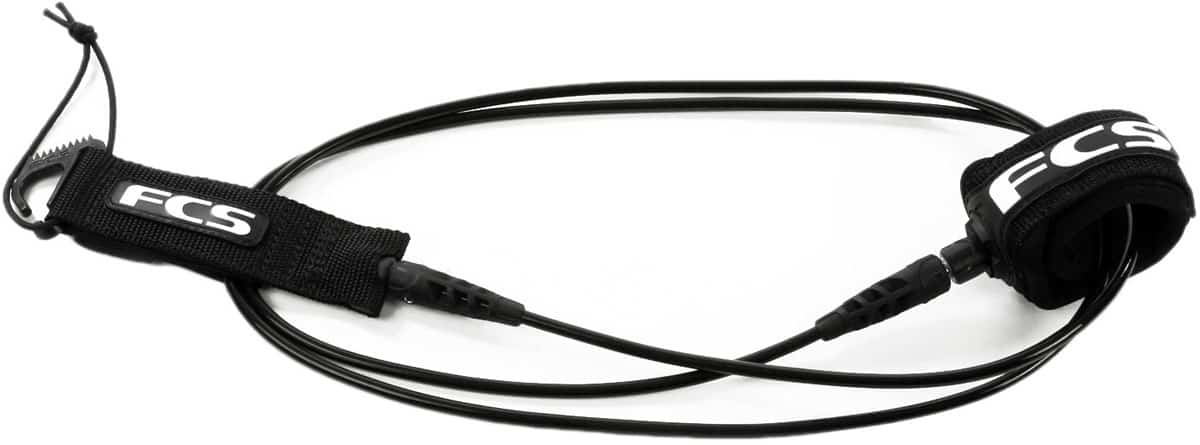
Today the modern surf leashes are made of urethane. Urethane gives just enough stretch to ease the pull on you leg but it doesn’t make your surfboard snap back when the water releases it. BTW – it is still a good idea to protect your head with your arms when you surface after a wipeout (tested:) ). Leashes come in various thicknesses and lengths. The ankle strap which is usually Velcro is attached to the urethane with metal swivels. You attach you leash to the surfboard via a leash cup. Cup is a piece of plastic with a small metal bar in it that is laminated into the tail of the surfboard. Leash is then attached to the metal bar. Some of other innovations when it comes to leashes are: quick-release, rail-savers, single and double-swivel attachments, single and double-wrap ankle straps.
How To Buy it?
Length
Leash length is the first thing to check out. Itshould be approximately equal or slightly longer than your surfboard. For instance – for 6’7″ surfboard use a 7′ leash. If leash is to short you will feel it pulling your back leg when you move around. The surfboard will also snap back faster if the waves are bigger. On the other hand, if it is to long it will drag in the water and slow you down, it will have a will of its own and it will keep running in between your legs.
Thickness
Leash thickness is related to wave size. If you will surf extra large waves, get a thicker one than normal. Usually there is a note on the leash for what wave height it is meant. The other extreme are competition leashes. In competition the main concern is speed. Thinner cords means less drag in the water and faster surfing. It is not that important if the leash breaks. Unless you are surfing small beachbreaks just use an ordinary one.
Velcro ankle strap
Make sure that it is comfortable and well stitched.
Swivels
Swivel points help reduce tangling of the leash. They let the leash turn so it does not become twisted. There should be a swivel point where the cord meets the ankle strap and one where the cord meets the rail saver.
Rail saver
Rail saver is a wide strap section at the end of the leash that attaches to the surfboard. Rail saver protects the rail and the tail of the surfboard from the cord. As leash is thinner it can dig into the surfboard if the wipeout is hard. All leashes today have rail saver pieces.
Key Pocket
Some surfboard leashes have a key pocket in the velcro part that comes around your ankle. If you need it check if it is big enough for your keys. The pocket can be to small for some car keys. Then again, having a big car key tied around your ankle is not very comfortable and can also be the cause for the leash to release from you ankle.
How to attach your leash?
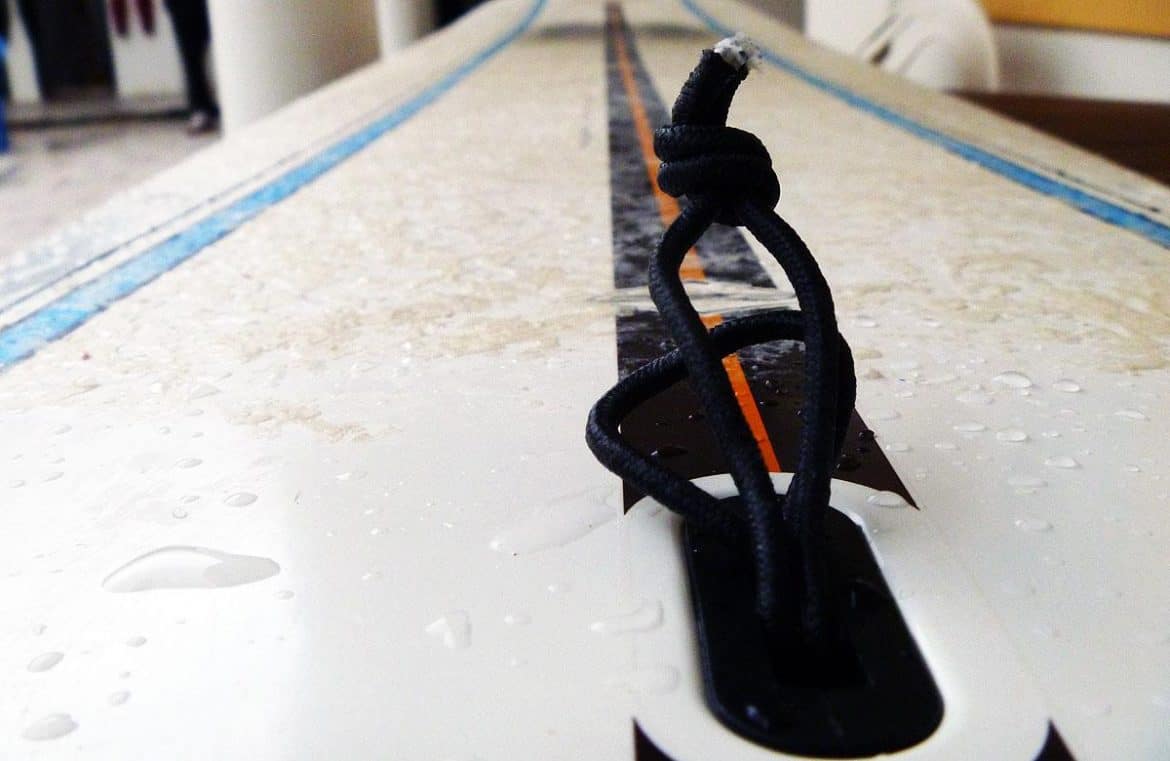
Just use the nylon rope that comes with the leash. You can pull it through the leash cup so the knot keeps the leash in place or you can pull the loop through the leash cup and then pull the knot through the loop. Then you fasten the knot into the leash. Either way, just make surf that the nylon cord is not too long. It must not reach the rail of the surfboard as it can make a lot of damage to it during a wipeout. Make sure that the rail saver strap comes over the rail not the cord!
Maintenance
Not to much to tell here. Just two things – wash your leash together with your surfboard after the session with fresh water and make sure the Velcro strap if closed at all times when you are not using it. Wash away any sand that comes into it and you will be able to depend on your leash when the wipeout comes.
Great! More kooks in the water.
I’m in the process of buying a super fish surf board with a swallow tail and am still learnin. Do I need a tailpad on this type of board or should i just wax it and take it out. please send me an email bak. thanks
Haven’t seen much tailpads on the fishes, I think its the clash of the styles. Retro fish and new school tailpad :)? But at the end this is your personal choice. If you are a beginner – tailpad helps you with your foot placing – as you pop up on the board you will feel right away if your back leg is in the right spot.
…uh, I can’t see your email, but I think it is better to share things here, so anyone can see. cheers
Alex, ec is right. Maybe just one other thing, with boards that ride a little more with the front foot or if you are more a front foot surfer, that it makes less sense to put a tailpad on, but if you put it just for the foot placement it’s worth it.
i just got a surf board, but it has no leash. i mean there is no where on the board to put a leash in through. is there a leash that can go in one of the fin screws or where could i get it done? or am i just screwed. i live in guadalajara mexico. i really want to get this baby in the water. its a hyperlite landlock 5′-6”. help
Beto, I think this is a wakesurfboard, meant for wakeboarding. Thats why it has no leash plug. It is not meant for surfing. I dont know exactly how the board looks and if it would be possible to surf with it…I doubt it. Otherwise any shaper can install a leash plug.
Beto:
Some people are just dumb as f*ck. In this instance, that means you.
If you BOUGHT and CONSCIOUSLY PAID MONEY for a wakeboard thinking it was a surfboard – a “bad boy” in fact – you’ll be a danger to yourself and everyone around you in the ocean.
What’s ur next question sh*t for brains? “Do I need to learn how to swim good before I surf Pipeline?”. Or “What if the waves are scary and Mommy isn’t there – the other surfers will hold my hand right?”
Go hang out in the shallow end at the public pool. “What’s the shallow end?” – you ask. It’s the end that has all the magic yellow water in it for playtime!!! And no, you don’t need to wear your diaper. Just hold the number 2’s like a big boy, OK?
Seriously, stay out of the ocean. You’ll kill yourself and/or the people who come to rescue your dumb ass.
Fucking moron.
Does anyone know where to get longer lengths of leash (30 feet)?
Wow, BARNEYS DREAM HAS BEEN ANSWERED! To bad this website dosnt explain about Barneys palce in the surf world, or his lack of. It seems with “surf schools” and sites like this, we could have Austrians surfing with us…wait! we already`do! I got new for you 360- you are cutting down the rainforest!
Hi,
It might be hard to believe but I surf in barcelona and I surf in about up to 2 meter waves.
What size leash should I buy, my board is 6,1 and i right now have a 6ft leash.
6ft leash is perfect
The surf lease was not invented by Pat O’Neill in 1991. Anyone that actually knows pat knows this fact.
I invented the Surf Leash in 1969. I was a senior at Santa Cruz High school and Pat was a Junior. I was a kneeboarder and Pat was a stand-up-surfer and we cut school together to surf.
He used to chide me “hey old man, are you going to crawl around on your knees for the rest of your life”. So I decided to learn stand-up. Easy it should be because I could stand on my knee-board with my swim fins on.
So I made a 4’7″ board and took it out to steamer lane. I rode my first wave then fell off and almost drowned. My entire experience in the ocean was with Churchill’s on.
After patching my board twice I went to orchard supply and bought a cartop-carrier suction cup and some surgical tubing and made the first Surf Leash.
After two weeks Pat and his friends started calling me “Gumbie” but it was what is now the cold water classic where the Surf Leash made it’s debut.
Pat asked me if I would make him one to use in the contest. It was in this contest in 1969 that he was disqualified for a competitive advantage.
I spent the next two years selling Surf Leashes to all the surf shops up and down the coast of California.
Get your story straight.
Wow Steve your story seems plausible and so no reason to not believe it so thanks for laying down the facts of the history of the surf leash as you should in all fairness and rights be given credit.. God bless bro
Back in the day I was given an first design surgical rubber & grey suction-cup surf leash by Steve Russ at Steamer Lane in Santa Cruz. The intent of the original leash was 100% to save the board from the rocks, not to make surfing easy. Although not perfect, Steve’s original design was the basis of all surf leases that followed.
Steve Russ > Pat O’Neill
Wave Tribe has been making fantastic recycled surfboard leashes since 2007. These leashes are made from recycled materials and are as strong as non recycled leashes.
Do you need a leash for Stand up Paddle boards?
If you surf with it then yes, on flat water mostly not.
Did Steve Russ ever make a surf board and named it surf more?
1969 1971?
I’m a 62 year old woman. I surfed Huntington and Newport back in the 70’s. My surfboards are now hanging on the wall in my bedroom in Utah. I’m LMFAO reading these comments. Thanks guys! Some things never change.