

It is difficult to credit a single individual for the creation of the modern wetsuit, but if you had to do it, it would be Jack O’Neill. How wetsuits came from “wool sweaters” to high tech battery powered wetsuits – History of the wetsuit.
First Wetsuit Ever Made
It is hard to decide on a single person and say – hey is the guy that created the modern wetsuit as people here and there were doing the same things. In the year 1951 a guy named Hugh Bradner who was working for the navy got the idea that a thin layer of water that is trapped under “something” could be an insulator against the cold water in the sea. His buddy suggested that neoprene would be a great “something” material to use. But Hugh Bradner was not that interested after all in the practical use and influences that a neoprene wetsuit would have on the water sport world (and elsewhere) and he never did anything about it, he never patented his design. But still Bradner is the first person that we can confirm (a letter dated June 21, 1951) way playing with the idea.
Another wetsuit pioneer was Bev Morgan, you can read more about him in the book “Diving Pioneers and Innovators” by Brett Gillliam. Although Bev was a quiet man, he is the only person in the world to be inducted into all three, the surfing hall of fame, diving hall of fame and commercial diver’s hall of fame. He was also an editor and photographer for Surfer Magazine. From the memories of his nephew Glenn Morgan: “He and my father cut, pieced and glued together the first ever neoprene sport wet suit in our garage in about 1955, which I witnessed and remember vividly. To my knowledge, Jack O’Neil modified this idea and added colors and a rear zipper. If there is more to this story, I am not aware of it.”
According to Legends of diving Bev Morgan met up with Bob and Bill Meistrell who were experimenting with various materials to delay the onset of hypothermia. Bev Morgan had read an article about a material that was foam neoprene and used by military divers. It was called “wet suit” because even though it would get wet, you would still stay warm. Bev and the Meistrells developed the wet suit “Dive N Surf Thermo cline” which later became known as Body Glove. This wet suit had a closed cell neoprene rubber instead of the latex coated canvas favored by the hard-hat divers. This new wetsuit would also help keep divers and surfers afloat. Bev sold his interest in Dive ‘N Surf to the Meistrells in 1958 and began diving commercially for abalone off the coast of California.
If you ask the average wetsuit user on the street, most would say that it was Jack O’Neill who invented the wetsuit and came up with the idea of using neoprene. Jack founded the O’Neill company together with his brother Robert O’Neill, who actually was the one in the O’Neill family that created the first wetsuit designs. Then again there are also But Bob and Bill Meistrell, from Manhattan Beach, California who founded Body Glove and they say they started to experiment with neoprene wetsuits in 1953. I guess all these people were not aware of each other work so it doesn’t really matter -they all contributed to what we have today.
Jack O’Neill
 In an interview Jack explained how he got into the surfing business: ” I always liked surfing, even when I was doing other things. Years ago I was working in San Francisco and on my lunch break I would go body surfing at Ocean Beach. Then I’d go back to work. I always felt great after spending time in the ocean, but a lot of times my sinuses would take on a lot of water.
My very last job was selling architectural aluminum. I called on engineers and architects – people who designed and built buildings. Now this was back in the days before computers, and a set of architectural renderings or blueprints was very difficult and expensive to duplicate.
I think you can see where this is going… One afternoon after my surfing break I was leaning over a drafting table with one of my architect clients and all that water in my sinuses poured out all over the set of original drawings we were examining.
I lost that job a couple of days later and decided to go into the surfing business. I went out and bought a load of balsa wood so I could shape some surf boards and opened the first Surf Shop. I also kept looking for better ways to stay warm in the water. I made a few vests and people bought them and I just kept going.
Back then, San Francisco wasn’t the most ideal market to open a surf shop. There were only a handful of die-hard surfers in the area and it was actually illegal to go in the water on Ocean Beach at that time. But I was doing something I liked to do and it all worked out.” Jack O’Neill.
It worked out all right! There are only a few places on Earth where you can surf the whole year without a wetsuit and there are only a few people that are willing to surf freezing cold water only in their trunks. So without a wetsuit, surfing wouldn’t be anywhere near to where it is now.
“Surfing in the 50s was great,” said Jack. “You knew everybody and we often took turns on the waves.” That was the positive side, but on the other hand surfing at that time meant suffering the cold water temperatures and escaping from the water much sooner than the surfers would like to. Surfers did all kinds of stuff to keep themselves warm. Stuff like surfing in wool sweaters, surfing dressed in a navy jumper and a special advanced technique – surfing in wool sweaters soaked with oil so they repel water. There is no need to explain that sooner or later (that means after a half hour or so) every surfer, even those in wool sweaters would gather outside around the fire and try to warm themselves. The wetsuit of choice at the time was a pair of bunhuggers and maybe an old bathing cap.
Jack O’Neill wanted to do something about that and he started experimenting with surfing vests. At first he was using unicellular plastic like PVC which had good insulating properties but it was very hard to work with. He stuffed some of it under his bunhuggers. Later he started making vests out of plastic foam but it didn’t quite work. Until Jack Jack O’Neill found neoprene.
Neoprene was a really good insulator in was buoyant and flexible. Now Jack could really start producing wetsuits. He designed a short john and a long john, a spring suit and a full suit. He even designed those beaver-tailed jackets that close under your crotch. Jack remembers that he got a lot of laughs from the surfers that came from the south and saw his creations.
Jack passed away in 2017, to learn more about his life check also Jack O’Neill tribute.
Wetsuit design history
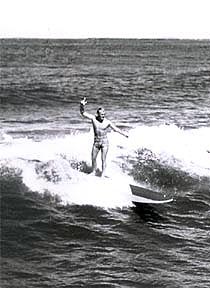 Even with the use of neoprene the first neoprene wetsuits could not be compared to modern wetsuits of today. Fist wetsuits from the 1950’s were stiff and did often not fit very well, so they were really uncomfortable and you got a lot of flushing. Neoprene used to make them was raw foam-rubber neoprene that was unlined – it was without any backing material. The problem of unlined neoprene is that it is very sticky and very fragile. If you pulled your suit on too hard, you could tear it apart which was not very hard to do as it was sticking against bare skin. So surfer used talcum powder to slip into their wetsuits.
When nylon was developed it was a perfect solution for a backing materials. A layer of nylon was applied to one side of the neoprene. Nylon is still used today, but its performance is much improved. Single nylon lined neoprene made putting on a wetsuit much easier than it was before. Nylon took most of the strain of pulling on the suit so the neoprene did not tear. But the outer side of neoprene was still exposed and the first nylon was very inflexible, so the wetsuit were also quite stiff.
Double lined neoprene was “invented” in the 1970s. Double lined neoprene is protected with nylon from both sides. Protection and tear-resistance of the neoprene was increased, it was also possible to color the outer nylon layer and make colorful wetsuits (or maybe not, if you think of the brilliant fluorescent colors common in the 1980s, yikes!).
How first wetsuits were made?
Simple, take two sheets of neoprene and sew them together. Simply by overlapping the edges of both neoprene sheets. Simple but not very effective. Punching holes all the way through both layers of neoprene opened the inside of the wetsuit to the environment. Another problem was stretching of the neoprene that only made this holes bigger. The result was lots of flushing through the seams. When single lined neoprene was introduced holes stopped growing with use, but they were still there. So another method of sewing neoprene had to be developed.
Evolution of wetsuit stitches
Seam taping
Seam taping was the solution for some of the problems. Seams were taped with a strip of nylon that sealed the seam and stopped the water. The tape was actually melted into the neoprene by heat. When the neon color revolution came, the tape had to be moved to the inside of the wetsuit where nobody could see it.
Seam Gluing
Another idea was to glue the neoprene sheet edges together instead of sewing them. This stopped the water and the seam were smooth and flat. But big problem was that neoprene/glue/neoprene combination wasn’t strong enough and could tear. Cutting the neoprene panels from the neoprene sheets was done by hand and if two panels were not cut well there were still holes along the seams.
Blindstitch Revolution
Blindstitch was the solution. After nylon-backed neoprene was invented, the blind stitch sewing was also developed. Blindstitch is called a blindstitch because you can not see it. A curved needle that is used for blind stitch sewing is designed not to go all the way through the neoprene but just under the surface of the material and comes back up on the same side. So the neoprene is sewn together without punching a hole all the way through. No holes – no water. Blindstitch seams are also flat and more comfortable. Today blindstitch is the primary method of sewing wetsuits, especially wetsuits for warmer conditions.
Modern Day Wetsuits
Wetusits keep getting better and better. Lighter and more stretchy neoprene, limestone based neoprene, plant based neoprene, more air bubbles and more insulation, better and more high tech internal lining, fast drying internal lining etc… It was only a question of time for the ultimate solution – not only warmth by insulation but also warmth by heating. The first heated wetsuit was introduced by Rip Curl in 2007. It is still produced and available but it seems that production turned more into the heated vests that can be used under any wetsuits and are cheaper and more versatile (btw – here is a review of one of these heated vests). Heated wetsuits didn’t really take over the market, probably because regular wetsuits have improved so much that you can use them to surf or do other water sports virtually anywhere. And for those really extreme instances with freezing cold water temperatures, people use dry suits.
If you want so get more info on other features of modern wetsuits, read our full wetsuit guide.
Would a wetsuit in use in 1982 look very different from a wetsuit today? Were the same styles available?
80’s were the neon period so you could probably spot a bright neon yellow wetsuit from that time from a mile away :) but otherwise, I’m not sure if you could see much difference from a distance. But as soon as you would get a closer look the difference would be quite noticeable.
this webbie is welll good x
Awh how cool
this is so sick i no more now:)
I LOVE THIS WEBSITE SO MUCH I SPEND NEARLY 23 HOURS A DAY ON IT:);):D;D:o8):P:-*
how gay is jake ryan
hehehehehehehe
DIPPA YOU SPUD:o
i cant live without him:)
i have a girlfriend but i still really want to be with a man;)
and i want that man to be with josh watt and josh peters:)
Yea man, Jake Ryan is an absolute fuckwit.