
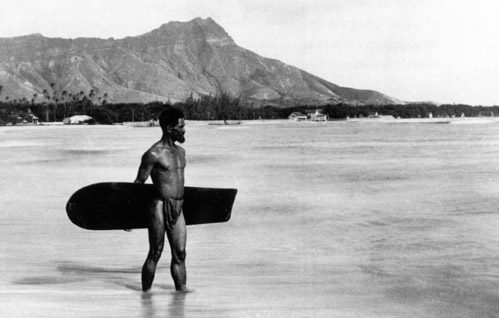
We came a long way in the history of surfboards. Can you imagine riding a 35kg/77lb heavy wooden surfboard with no fins and no rocker? I can’t. This is exactly how the first solid surfboards looked like. So these days we can be grateful for new materials and light surfboards that fit under our arm as the fist surfers were (actually would be, if they knew what lays ahead) grateful for clean oceans and empty lineups. How surfboards evolved through history from unimaginably heavy wooden planks to light and maneuverable surfboards? Read on…
Table of Contents
Solid Surfboards
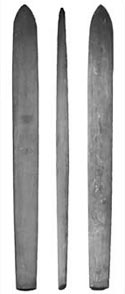 What are solid surfboards? The name speak for itself – a solid surfboard is made out of one solid piece of material that is most likely to be wood. They have been in use since ancient times and their use was recorded by ancient explorers and travelers including the Englishman Captain Cook when he visited Hawaii in 1777. Actually – his diary is also the first written document that mentions surfing.
Wood used to make solid surfboards came from a variety of different trees depending upon what was available locally. For example in California – Redwood was commonly used. In ancient Hawaii, where surfing was a part of the culture, surfboards were more that just big pieces of wood. Special types of trees could only be used by Hawaiian Royalty to shape their own royal surfboards.
Needless to say, a solid wooden surfboard does not float as well as a modern surfboard made out of foam. To compensate for this, old boards were just a little bit longer and heavier than modern surfboards.
You had to be in good shape just to bring your surfboard to the beach!
Solid surfboards could be anywhere from 10 feet (3m) up to 20ft (6m) long and were extremely heavy (they started at around 35Kg/77lbs and went up to 68kg/150lbs or even 91kg/200lbs). Once you trucked your surfboard to the ocean you found another bug in these surfboards – old solid surfboards had no fin and no rocker, so they could only be surfed in a straight line. Good side of this was that one wave one surfer rule was none existent and everybody could ride the same wave. There were also no feather light groms in the water as they were unable to move the surfboard from daddy’s garage.
Solid surfboards were still in use up until the late 1930’s.
The worlds oldest surfboard?
The world’s oldest surfboard is displayed in the Bishop Museum in Honolulu, Hawaii. It celebrated more that 230 birthdays. The board was used on Hawaii and was ridden by Hawaiian royalty. It dates back to the time when Captain Cook first saw surfing in the Hawaiian Islands in 1778.
Hollow Surfboards
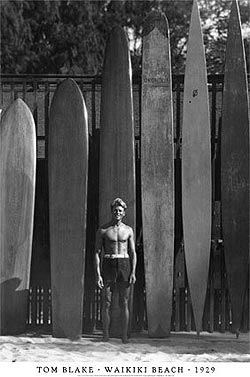 It is obvious what was the problem with old solid surfboards besides the fact they had no fins and no rocker – they were to heavy and had to little buoyancy. The logical thing to do next was to make a hollow surfboard and reduce the weight.
New materials and techniques brought the use of marine plywood and waterproof glues into surfboard construction and made it possible to build a hollow surfboard. They were constructed using a wooden framework which was covered with plywood and then varnished.
Who came up with the idea of a hollow surfboard?
Hollow surfboards were invented in 1926 by a surfer named Tom Blake (1902 – 1994). Besides being one of the most influential and important figures in the history of surfing Tom Blake was also a national swimming champion, inventor, author and actor. Hollow surfboards soon replaced the old solid surfboards. They were much lighter (around 20kg/44lbs) and easier to handle. Still the shapes of hollow surfboards were similar to solid boards which gave them the same “poor” performance. These hollow-core surfboards dominated the surfing world until the late 1940’s.
Lets Rock – Who Invented Surfboard Rocker?
The invention of the surfboard rocker could be credited to Bob Simmons (1919-1954). Bob Simmons is also the guy you could call the “Father of the Modern Surfboard”. He introduced number of innovations and new shapes. Bob Simmons was constantly experimenting with surfboard designs. One of them was called Simmons Spoon. Spoon had a kicked up nose and from this shape on Bob Simmons made surfboards with a little curve instead of being straight. This was the beginning of the rocker in surfboards.
Surfboard rocker is the most important design feature on a surfboard, since it has a great influence on the water flow. Even small changes in rocker make quite a difference in performance.
Surfboard fin invention
The first fin
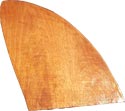 The first fin was placed on the surfboard by Tom Blake in 1935 (I told you he was one of the most influential and important figures in the history of surfing).
Tom Blake had this to say about his first time out with a newly invented fin: “When I first paddled out the board felt like it was much easier to keep in a straight line, although I thought I might be imagining it. My first wave revealed the truth. Never before had I experienced such control and stability. There was much to work out, but the seed had been sown.”
The surfboard fin prevents the surfboard from sliding sideways on the wave. Before the invention of fins, surfers would stabilize the surfboard by hanging the toes of their back foot over the edge of the board. Fins allowed surfers to direct the board and keep it stable.
The single fin
Surfboard fin as we know it today was developed by George Greenough (surfer from Santa Barbara, California, now lives in Byron Bay, Australia) in the late 1960s. Before George the fins were more like keels – pretty much useless by today’s standards. The single fin did not change until the late 70’s.
Twin fin
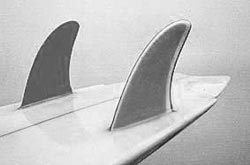 Then an Australian surfer Mark Richards (aka MR, born in march 1957) added a second fin to the surfboards tail, which allowed him to make more flowing carves. Mark Richards cashed in his new twin fin setup and his surfing mastery by dominating the world competitive scene from 1979 to 1983 and winning four world titles.
Now we are almost at the end of fin evolution.
Three fins – Thruster
In 1980 another Australian surfer Simon Anderson was developing a fin set up that again changed the surfing world. Simon Anderson attached a third fin to the surfboards tail and positioned it centrally behind the twin fins. Three fin set up is also called the thruster set up. Simon Anderson blew away most of the doubts about the thruster by winning a world cup event on his new surfboard. Most of the surfboards today have a thruster fin set up that allows smooth carving turns, gives control over the surfboard and provides drive on the wave.
Four fins – Quad
It is funny that four fin setup was discovered at about the same time as the thruster. But since the 3 fins took the surfing world by storm aided by the big success of Simon Anderson the four fin brother stayed in the shadows until recently. These days they are quits popular. Why? This is a comment from one of the riders: “I find they are faster because they don’t create as much drag as a thruster because there’s no center fin. With a quad, the water just flushes out the back of the board, as there is a lot more area there in between the rear fins allowing it go faster.”
Removable fin systems
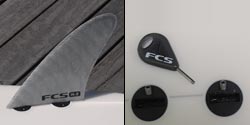 Removable fin systems were developed in the late 90’s. Removable fin system allows you to take off the fins from your surfboard for transport and even more important – to replace your fins with different fins that can alter the riding characteristics of a surfboard.
Surfboard Leash History
Surfboard leash was developed by Pat O’Neill and introduced in 1971. Before the invention of the surfboard leash surfers who fell off their surfboards had to swim to the shore to retrieve them. Surfer without a surfboard caught in the ocean and big surf can be in danger (strong currents) and has to be a good swimmer to reach the shore. Loose runaway surfboards were also a danger for other surfers (think 68kg/150lbs wooden surfboard directed towards your head).
Pat O’Neill is son of Jack O’Neill, the inventor of the wetsuit. Pat O’Neill used a surgical cord and attached it to a surfboard with a suction cup. Pat O’Neill introduced his leash in the 1971 Malibu international surfing competition, but he was disqualified from the event for wearing his leash. But surfboard leash proved itself and is today attached to 99% of surfboards. Later surgical cord was replaced with a less stretchy material. First leashes tend to overstretch and then launch the surfboard back towards the surfer. That is how Jack O’Neill lost his eye btw.
Modern Surfboards
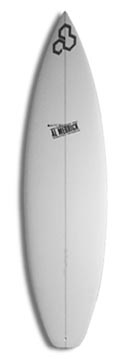 Modern surfboards – modern materials. The introduction of fiberglass in the 1940’s meant that strong, light, waterproof modern surfboards could be constructed.
Balsa Core
At first balsa wood (very light type of wood) was used as the surfboards core. Balsa core was hand shaped into the desired surfboard shape and then laminated with a thin fiberglass skin.
Foam Core
Balsa wood was later replaced with polyurethane foam that is still used today. It is much lighter and easier to shape.
Shortboard Revolution
But still – even with these advancements – most of the surfboard were in the 10′ range – longboards. Again George Greenough helped out. Together with Bob McTavish they started experimenting with shorter surfboards. Fortunately Robert “Nat” Young took one of their boards to the 1966 World Contest in San Diego and threw nose riding into the corner, committed surfing in the curl was here. The shorter length of the surfboards and the thruster fin set up paved way for the modern style of performance surfing. Light weight of the surfboards also enabled many more people to take up the sport.
Shaping Today’s Surfboards
So where are we today in the history of surfboards? Today surfboard design is something that is constantly experimented with. You can ride a 6ft (1.8m) twin fin or 12ft (3.6m) gun and everything in between. Although various other materials and techniques have been tried (like epoxy/Styrofoam construction), most modern surfboards were made (up until 2006) in basically the same way as they were 30 years ago. Using polyester resin to glass a shaped polyurethane foam core.
What happened then? In 2006 the biggest and best polyurethane foam blanks manufacturer (blank is base for every surfboard) – Clark Foam closed its operations. Clark Foam covered a huge share of the blanks market and now it was suddenly gone. There was a big gap to be filled and faced with this people started turning towards new materials and exploring new ways of surfboard construction.
Retro Movement
One last thing worth mentioning here is the “recent” retro movement. A called it retro but it’s actually a mix of things. First some very good surfers started experimenting with old school shapes – riding single fins, fishes and even old Hawaiian style alaias. Having fun. And then the having fun moved to “ordinary” surfers which stopped riding pro shapes and started riding shapes that help the enjoy themselves more (easier paddling & catching more waves). Today boards are generally shorter and have more volume than they used to.
For a full list of every possible wave riding surfboard (from shortboards to guns, from surf mats to wooden doors:) ), check this article.
Time will tell which way the surfboard construction technology and surfboard design will go and what will be the next chapter in the surfboard history. Until then…keep riding.
PS: check this article for some travel surfboard packing tips and this one if you are a beginner looking for your first surfboard.
Old Hawaiian surfboard had up to 200 pounds? Wow! :o It’s a good thing there were no leashes, you coul say goodbye to your leg.
this website is the shit. It helped me so much. I just did an informative essay with a speech based on the history of surfboards. I couldnt find anything i needed till i found this bomb ass site. Not only did it have shit loads of info on old boards it got into modern to. I ended up doing really well on both the essay and speech so thanks.
who invented the surf board
Lisa, I think the surfboard is so old that you can’t pin it to one person, especially because there are no written records from that time.
right, when Captain Cook visited Hawaii (1777) surfing was already in full swing :) and that is the first written record of surfing itself, first surfboard must had been invented long before that.
hi i am doing a project at school and i was wondering if i could get some pictures of ancient surfboards
Liam, try http://www.legendarysurfers.com, but it’s hard to get really quality and high resolution pictures…
Its totally interesting. You dont think about this kinda stuff when your surfing. You forget about how it all started its kewl to relearn it again :-*
hi, got some info 4 my assignment on this site, and i need to reference it… i was wondering if i could have an author and date of the info on the history of the surfboard?
Put a Frog board on the website (Byrne Board)
very useful site thenks Bra!
Kerri
hey, I’m doing a paper for woodshop, and I’d really like to thank the author for all of this really good information. It’s helped me alot!
Thanks!
thanks for the info. helped alot with my project. anyone know who invented the surfboard? just post here. thanks ;D
heyy.. my name is paige and i am doing a assesment on the changes and development of the surf boards i think that you should have put more pics. i mean your informations is good but i needed more pics thanks!! ;D
Are any surboards so mass produced that they just slap 2 pieces together and call it a board. I understand there are handmade boards and those that have been “shaped” by computer. Is there another way? Trying to compare technigues for a project.
There is a growing movement out there for more sustainable surfboard building materials to cut down on the pollution generated by the traditional board building methods. In short, people are going back to wooden boards, but made by modern methods. The “Tree to Sea” forum is one place to see what I’m talking about. There are various methods pioneered by people such as: Rich Blundell, Paul Jensen, Roy Stewart, Tom Wegener, and others. Some builders are using balsa, cedar, red wood, pine, and paulownia woods built around a ribbed frame and then oiled or fiber-glassed over.
tahiti is the home of surfing , by many years. also the twin-fin was around long before Mark Richards—–do your homework
hi im doing a project on the change in the design of the surfboard.Ive read on wikipedia tha the first boards were made by three logs tied together…whats the passage from this rudimental board to the ones made from only one piece of tree…sorry for my english, im italian
thank you
What a flash back! I was the Malibu trash guy from 1968 to 1971.
Great years, I remember O’ Neil showing up with that leash, caused quite a commotion. Also, remember the Auzies coming with their V-bottoms. In those days I Knee boarded the 3rd pt. Everyone was pretty cool… I was the guy who kept the beach clean.
We had to do a research project on an invintion in school, so I chose the surfboard!! Thanks to this site, my project was a success!!! Thanks!! :D
this text is the greatest
i spent ages looking for something like this for my assinment now ive found what ive been looking for.
thanks writer happy surfing ayye
My Name is ryan doherty and i recon that i am the best surfer in australia and really think this is a helpful website, though my dad greg doherty said that our ansestor Archy doherty created the fist surf board in 1745, he was the first englishmen to discover hawaii before Captin james cook, though he didnt get any of the credit, he was sent to dicover places and sail back home to tell Captin James Cook that was he discovered was worth discovering, this website is a load of shit i personally think that all you kooks dont have a clue what your talking about.
Yours sincerly Ryan Doherty ;D
That is really cool!;)im doing a project on the surfboard and im going to take your word on this website cuz i belive you;)about the rocker dude that is the stupidest thing i havr ever heard
why am i weirdly addicted to this site
THIS IS A FANTASIC WEBSITE AND WAS VERY HELPFUL AT SCHOOOL ;);););)
Jack O’Neil is usually credited with inventing the wet suit, but I might suggest that you read about the invention of the first neoprene sport wet suit by my uncle Bev Morgan in the book “Diving Pioneers and Innovators” by Brett Gillliam. Although Bev was a quiet man, he is the only person in the world to be inducted into all three, the surfing hall of fame, diving hall of fame and commercial diver’s hall of fame. He was also an editor and photographer for Surfer Magazine. He and my father cut, pieced and glued together the first ever neoprene sport wet suit in our garage in about 1955, which I witnessed and remember vividly. To my knowledge, Jack O’Neil modified this idea and added colors and a rear zipper. If there is more to this story, I am not aware of it.
Hi Glenn, thank you for that input! I have added a section about your uncle to the article that covers the invention of the first wetsuit. You can check it out if you wish: https://360guide.info/wetsuits/wetsuit-history.html
I’m very intrigued by the picture at the top of this article. Does anyone know who the person is in the picture and when it was taken?
It obviously was taken at Waikiki beach.
Sorry Chris, I don’t have the information. Would be interesting to know, I agree.